
5 Things Every Woman Needs to Know About Her Housing Rights
The threat of losing your home, especially when it comes from an ex-partner, is terrifying. It strikes at the core of your security, stability, and sense of self. For women who have endured abuse, the threat of eviction is often a devastating tactic used to maintain power and control even after the relationship has ended. The fear is real, overwhelming, and isolating.
But you are not alone in this struggle. International human rights law recognises that what you are experiencing is not just a private matter or a personal dispute. It is a fundamental issue of safety, dignity, and equality. Powerful global principles have been established that can help you reframe your situation, understand your value, and advocate for your right to a safe and secure home. Let’s walk through five powerful principles that arm you with the knowledge to fight for your home and your future.
Your Right to a Safe Home is a Fundamental Human Right
First and foremost, it is crucial to understand that the right to housing is more than just having a roof over your head. It is a universally recognised human right to live in a place with security, peace, and dignity. This isn’t a favour granted by a partner; it is an essential right you hold as a human being.
International human rights bodies have been clear on this point: The human right to adequate housing is the right of every woman, man, youth and child to gain and sustain a safe and secure home and community in which to live in peace and dignity.
Here’s why this matters to you: it shifts the conversation away from being a personal or domestic issue and reframes it as a violation of a fundamental human right. The word “dignity” here is key. It means you have a right to a place of healing, a space free from fear and control, the very foundation you need to rebuild your life. When your ex threatens your home, he is not just threatening a piece of property; he is threatening your right to security and dignity, a right that is protected under international law.
Leaving an Abusive Partner Should Not Lead to Homelessness
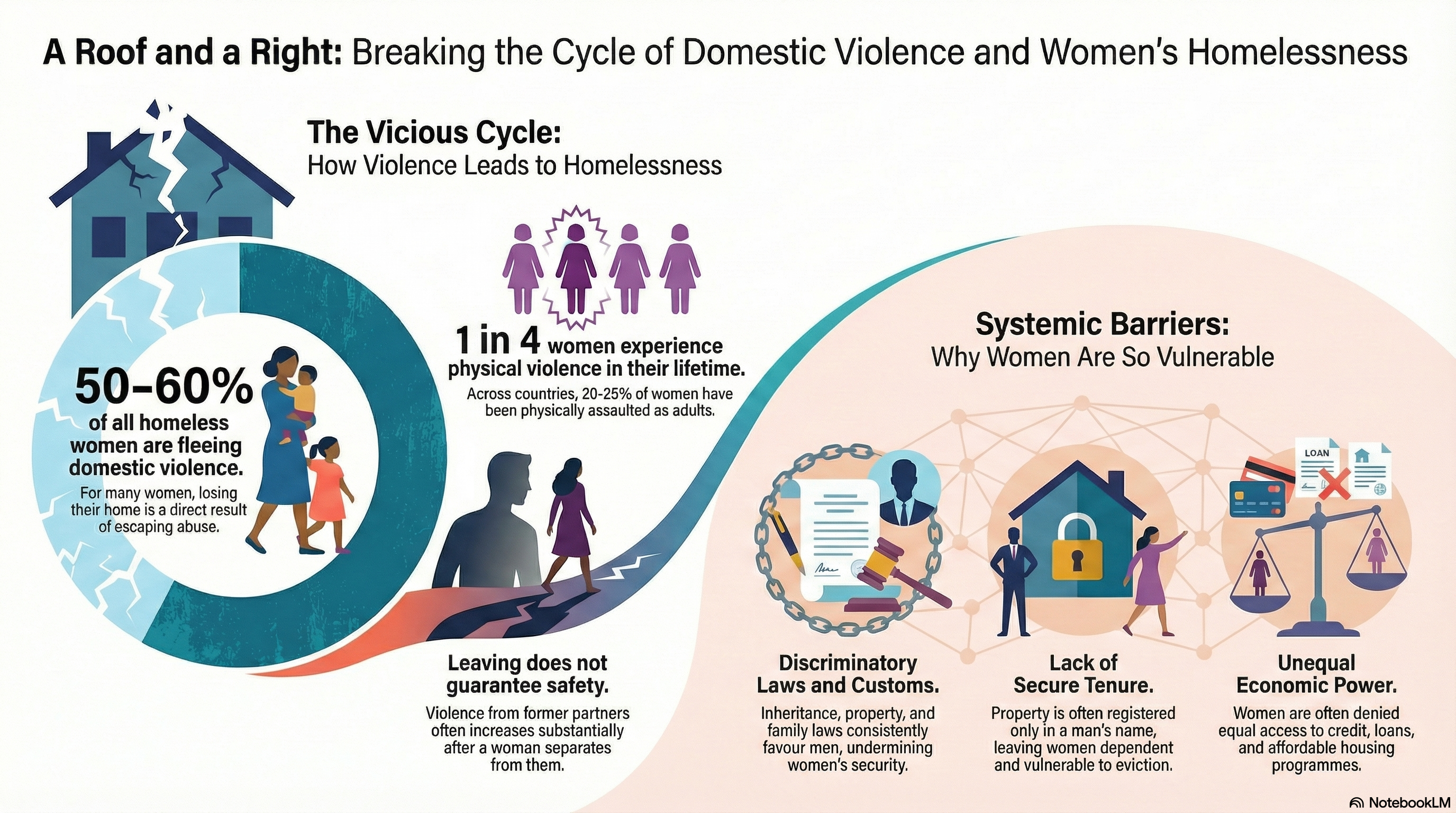
The fear that leaving an abusive relationship will lead to homelessness is a heavy burden, and unfortunately, it is a reality for too many women. Statistics paint a grim picture: approximately 50-60% of all homeless women report that they are fleeing domestic violence. Furthermore, rates of violence by former partners after separation are substantially higher, showing that the danger does not end when you walk out the door.
For a long time, international institutions overlooked this direct link. However, that has changed. Global and regional bodies now recognise domestic violence as a critical factor in women’s homelessness. Courts have affirmed that governments have a duty to protect women from this outcome. In the case of Kalucza v. Hungary, the European Court of Human Rights found that the state had failed in its duty to protect a woman from an abusive partner, a failure made even more significant because it was “despite repeated requests to have him evicted from their shared flat.”
What this means in practice is that you have the right to demand that the state protect you from being made homeless by an abuser. Your safety and housing security should not be the price you pay for escaping violence.
Your “Invisible” Work in the Home Has Real Economic Value
In many relationships, one partner, often the woman, takes on the primary responsibility for unpaid domestic labour. You may have cared for the children, managed the household, or put your own career on hold to support your partner’s. Abusers often devalue this work, making you feel financially dependent and powerless.
Human rights law, however, takes a different view. It champions “substantive equality.” Here’s the difference: Formal equality is when a law sounds fair to everyone. Substantive equality is when a law is actually fair in the real world, recognising that women’s unpaid work and sacrifices create a disadvantage that the law must actively correct. Upon the dissolution of a relationship, states are obligated to ensure equality in the division of all property accumulated during the marriage.
Crucially, this includes recognising the value of indirect, non-financial contributions. International standards explicitly state that your “invisible” work has tangible economic value and must be considered. This includes:
- Household and family care
- Lost economic opportunity (such as interrupted education or employment)
- Tangible or intangible contributions to a spouse’s career development
This principle is your legal foundation for demanding that a court recognise the years you invested in your family’s well-being, even if your name isn’t on the bank account or the property title.
Watch Out for Hidden Discrimination in Laws and Customs
Discrimination isn’t always obvious. Sometimes, it is hidden in laws, policies, or long-standing customs that seem neutral on the surface but disproportionately harm women.
For example, laws that refer to the “head of the household” almost always default to the man. This can prevent a woman from being named on property titles or land certificates, leaving her with no legal claim to the home she has helped maintain. Similarly, many discriminatory customary and religious laws regarding inheritance grant women a lesser share of property, or no share at all, and are often used to dispossess widows.
International bodies take these discriminatory practices very seriously, condemning even deeply entrenched traditions that violate a woman’s right to equality. As one committee stated: “polygamous marriage contravenes a woman’s right to equality with men, and can have such serious emotional and financial consequences for her and her dependants that such marriages ought to be discouraged and prohibited.”
The message here is powerful: If an institution as deeply embedded in some cultures as polygamous marriage is condemned by international law for the harm it does to women, then customs that deny you a home and your fair share of property are just as clearly violations of your fundamental rights.
You Are Protected from “Forced Eviction” Even by a Family Member
The term “forced eviction” might bring to mind state bulldozers, but its legal meaning is much broader and more personal. Human rights bodies define it as: “the permanent or temporary removal against their will of individuals, families and/or communities from the homes and/or land which they occupy, without the provision of, and access to, appropriate forms of legal or other protection.”
A forced eviction is considered a “gross violation of human rights,” and this protection is not limited to actions by the state. Women are especially vulnerable to forced eviction by private individuals, including spouses, partners, or in-laws. The practice of “property grabbing,” where a deceased husband’s relatives dispossess his widow and children, is so serious that States are obligated to ensure it is criminalised and that offenders are duly prosecuted.
This leads to a game-changing concept: “due diligence.” It means the government cannot wash its hands of your situation just because the abuser is a private individual. The state has a direct, active responsibility to prevent the eviction, investigate your claims, and provide you with protection and a legal remedy. You can use this principle to argue that the state must act to protect your home, because seeing it as a “private matter” is a failure of its human rights obligations.
Conclusion: Your Home, Your Future
The threat of losing your home is a weapon used to instil fear and maintain control. But knowledge is your shield. Your right to a safe and secure home is not a favour to be granted or taken away by a partner—it is a recognised human right. Your contributions to the home have real, legal value. And you are protected against being wrongfully thrown out. This understanding is the first step toward reclaiming your power.
Knowing that your right to security is supported by global principles, what is one step you can take today to start planning for a safe and stable future?
Help us lay the foundation for healing. Donate $25 today to cover our essential startup costs so 100% of my book royalties can go directly into supporting women’s transformation.
https://linktr.ee/lifechangeplans
https://donorbox.org/support-lifechangeplans