
5 Shocking Ways Family Courts Fail Domestic Abuse Survivors.
Family Court Human Rights Failure. Family courts are supposed to be a refuge for those escaping domestic abuse—a place to secure safety for themselves and their children. But for a staggering number of survivors, this assumption is dangerously false. Instead of finding protection, they discover the family justice system can become another arena for abuse, perpetuating trauma rather than ending it.
This is not just anecdotal; it’s the core finding of a groundbreaking six-country research study by Professor Shazia Choudhry and her team, which gives a voice to survivors, judges, lawyers, and experts. These are not isolated academic concerns; Professor Choudhry’s work provides the backbone to warnings already being issued by international bodies like the UN, highlighting a systemic crisis playing out in courtrooms across the globe.
1. The System Becomes a New Weapon for the Abuser
Separation is one of the most dangerous times for a victim of domestic abuse. Yet this is precisely when perpetrators weaponise family court proceedings as a tool to continue their abuse, coercion, and control, a phenomenon known as “legal systems abuse.” This isn’t an isolated problem; it is a pattern identified as a key finding of the six-country study. In the most tragic cases, these systemic failures have fatal consequences, as court-mandated contact creates the opportunity for perpetrators to murder their former partners and even their children.
The impact on survivors is devastating. The very system designed for protection becomes implicated in the perpetuation of abuse, with the majority of survivors in the research reporting that their experiences were made worse by engaging with the justice system.
As one survivor powerfully stated: “…He’s just swapped his fists for the system.”
2. Mothers Are Punished for Trying to Protect Their Children
Weaponising the court process is just the first step. The tactics become even more insidious when abusers co-opt discredited psychological theories to punish mothers for the very act of protection. A scientifically unsound theory known as ‘parental alienation’ has become a pervasive and damaging tool in family courts, and the study revealed widespread concern among legal professionals about its origin and usage. Now discredited by the European Association for Psychotherapy (EAP), deeming it a “harmful pseudo-science” due to a lack of robust evidence and its potential to mask child abuse.
Choudhry’s team uncovered a disturbing paradox: even where the term ‘parental alienation’ is officially discouraged or prohibited, like in Spain and France, its ghost still haunts the proceedings. Its core assumptions are widely applied under different names, with mothers being described as engaging in “alienating behaviours,” being “unco-operative,” or, in France, being a “mère fusionnelle” (an intense or smothering mother).
The consequence is that the concept is used to dismiss legitimate safety concerns. Women who try to protect their children from a violent parent are often accused of being “vengeful” or “delusional.” Their attempts to ensure safety are reframed as a malicious campaign against the father. A tactic that can result in them losing custody as punishment.
3. Different Courts Give Dangerously Conflicting Advice
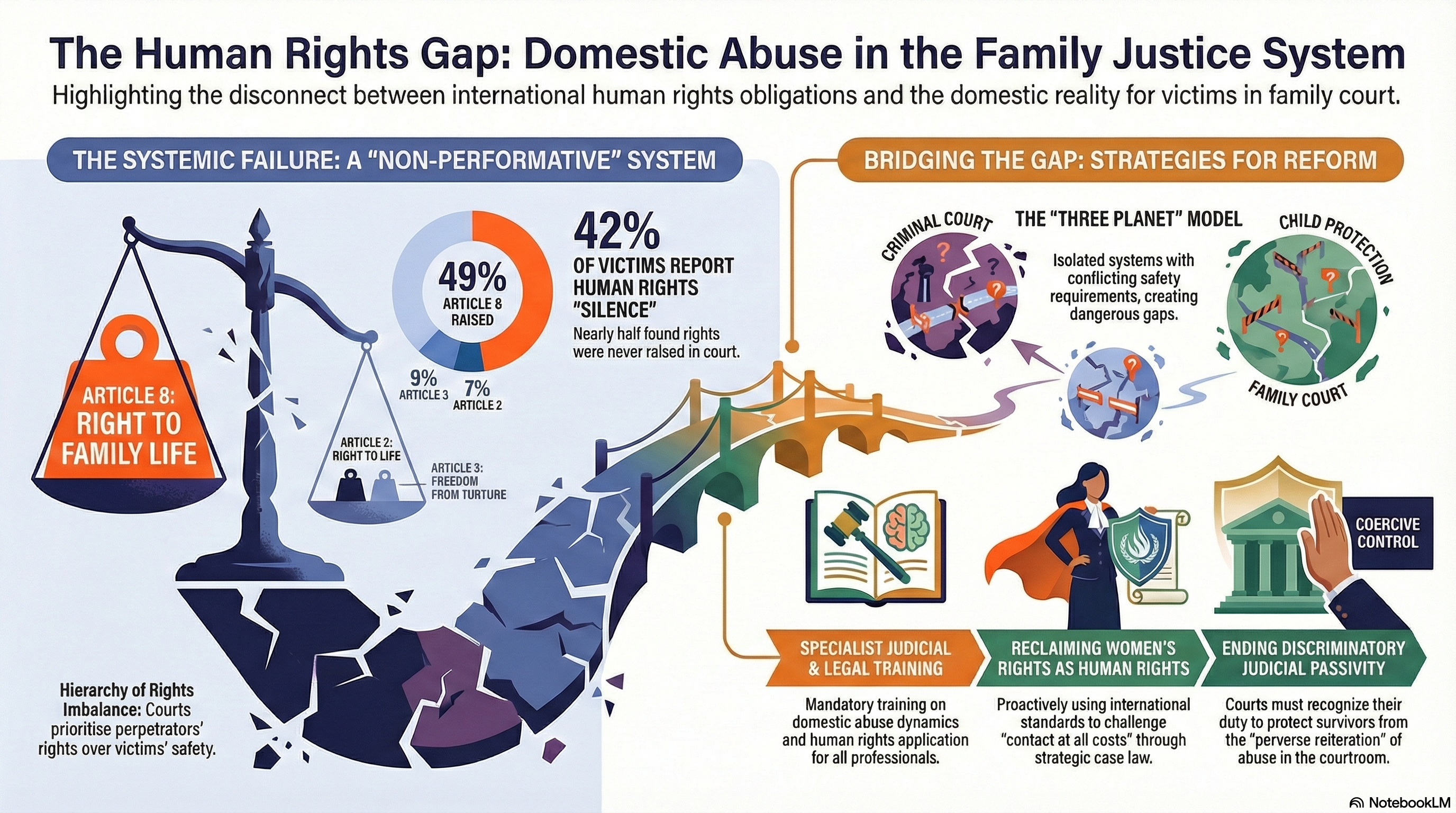
Professor Choudhry uses a framework originated by researcher Marianne Hester, the “three planet model”, to illustrate a systemic incoherence that traps survivors in an impossible bind. In my own situation, although I was not involved in Family Court, I did experience conflicting legal advice. I termed this as “stuck between a rock and a hard place”. The model describes three separate legal systems, each operating with its own conflicting logic: the criminal court, the child protection system, and the family court.
This creates a dangerous catch-22 for a mother escaping abuse:
- The Criminal Planet tells her she must not have any contact with the perpetrator.
- The Child Protection Planet tells her she must protect her children from the perpetrator, warning that if she fails, her children could be removed from her care.
- The Family Court Planet tells her she must allow and actively facilitate contact between the children and the same perpetrator.
This is not just poor communication between agencies. It is a fundamental structural failure that places survivors in an impossible situation. Any action they take can be used against them in one of the other systems.
4. A Glaring Double Standard is Applied to Mothers and Fathers
The research found that survivors across all jurisdictions felt that vastly different expectations were applied to them compared to their abusive ex-partners. Mothers reported immense pressure to conform to the stereotype of the “ideal mother”. One who must put aside her own trauma and experiences of abuse to facilitate the father-child relationship.
Worse, the study found that mothers are explicitly “held responsible and accountable for the continuation of the child-father relationship.” This cruel irony forces the victim to become the primary facilitator of her abuser’s access to their child. This glaring double standard is captured in the words of one survivor, who describes the impossible emotional tightrope mothers are forced to walk:
“When a mother goes into court, you have to come across very calm, you can’t show emotion, you can’t get upset if you get upset, well then you’re unstable… But if the father goes in and shows the motion, the judge will turn around and say well he’s hurting of course, he’s like that, he’s hurting, he’s not seeing his child, it’s so different how the two are treated.”
5. Human Rights Seem to Apply Only to Fathers
A profound and dangerous imbalance exists in how human rights are applied in family courts. The “right to family life” (Article 8) is frequently and successfully raised on behalf of fathers. In stark contrast, the absolute rights of the mother and child—the “right to life” (Article 2) and the “right to be free from inhuman and degrading treatment” (Article 3) are rarely argued or recognised.
Professor Choudhry’s analysis reveals this occurs because family courts often operate within an “unreconstructed liberal form,” reproducing the old public/private divide. This leaves the “private” sphere of the family untouched by the human rights obligations that apply to the state. The father’s rights movement has successfully created a public discourse that centres on their Article 8 rights, while the absolute rights of women and children to be safe from harm are ignored.
Survivors feel this disparity viscerally, reporting that the legal process stripped them of their own sense of humanity. One survivor’s testimony reveals the depth of this feeling:
“I don’t believe I had any rights in court i didn’t believe I had any equality or any equal rights in court it never came across like that we were there to make contact happen between father and child and that was it my human rights I just think they’re broken and they’re not even in the same picture i don’t think they’re in the same building.”
Ultimately, the research demonstrates a system where the rights of perpetrators to a family life are consistently prioritised over the rights of victims to be safe. Professor Choudhry terms this the “non-performativity” of human rights for women—rights that exist on paper but fail to be enacted in reality. I believe that Article 6 – rights to a fair hearing or trial should be considered when there is bias, discrimination and misogynistic attitudes by legal professionals and judges, as well as Social Services.
Resources Used.
When Womens Rights Are Not Human Rights. Talk by Professor Shazia Choudhry
The Family Justice Response To Domestic Abuse
When Justice Becomes a Sword:
Understanding Legal Abuse and the Hidden War Against Women
The research reveals a deeply troubling pattern where the family justice system, intended as a shield, too often functions as a sword that perpetuates the cycle of abuse. The findings show these are not isolated incidents but systemic failings that demand more than procedural tweaks. They demand a profound cultural change within the very institutions of justice.
For many women, leaving an abusive relationship is the hardest thing they will ever do. We are told that once we walk away, the nightmare ends. We are told the law will protect us. But for a staggering number of survivors, the courtroom becomes the new battlefield. There are many books written by survivors that focus on the topic of “Divorcing A Narcissist”
This isn’t just a “difficult breakup.” It is a systemic failure where the very institutions designed to provide safety are being weaponised to perpetuate harm. From the “precarious eviction” laws in Spain to the inconsistent application of human rights in the UK, the gap between legal theory and lived reality is a chasm that many women are falling through.
Beyond Physical Violence
One of the most dangerous myths about domestic abuse is that it requires a “black eye” to be real. Research by Professor Shazia Choudhry (University of Oxford) highlights a troubling pattern: the legal system often struggles to recognise—or flat-out ignores—non-physical violence.
Psychological, emotional, and economic abuses are frequently dismissed as mere “parental conflict” or “he-said, she-said” drama. This minimisation paves the way for what we now call Post-Separation Abuse.
“Numerous studies have also identified how gender-based violence is minimised, downgraded to parental conflict, denied altogether or associated with alcohol and drug abuse, mental disorders or family and personal issues.” — Professor Shazia Choudhry
When the law fails to see the invisible bruises of coercive control, it leaves women vulnerable to a “death by a thousand paper cuts”—a slow, agonising process of legal and financial attrition.
Litigation Abuse: The Courtroom as a Tool of Control
If an abuser can no longer control you in the home, they will use the court to do it. I have referred to this as litigation abuse or legal intimidation.
In my own journey, documented in the book Post Separation Abuse: Betrayal & Abandonment (written under the pen name Loren Keeling), I experienced firsthand how the legal system can be used to silence a survivor. After eleven years in a relationship, the “four-sentence discard speech” was only the beginning. What followed was a five-year legal battle involving Spain’s “precarious eviction” laws and a terrifying attempt to silence me through criminal defamation charges. The sequel to my first book, “Deceptions and Illusions: Embroidered With Truth”, will be published this year.
Why does this happen?
The research suggests three main “planets” that rarely align:
- The Criminal Planet: Focused on punishing the perpetrator.
- The Child Protection Planet: Focused on the immediate safety of the child.
- The Family Court Planet: Often focused on “parental contact” at all costs, even when that contact puts the mother and child at risk.
This “Three Planet Model” explains why a criminal court might tell a woman her ex-partner is dangerous. While a family court orders her to hand her child over to him for the weekend.
The “Non-Performativity” of Human Rights
We talk a lot about “Women’s Rights are Human Rights.” But in the family justice system, tThis “Three Planet Model” explains why a criminal court might tell a woman her ex-partner is dangerous, while a family court orders her to hand her child over to him for the weekend.hese rights often become what Professor Choudhry calls “non-performative.” They exist on paper, but they are not enacted in the courtroom.
For many survivors, the experience of seeking justice feels like a stripping away of their humanity. One survivor’s testimony from the Oxford research captures this perfectly:
“I don’t believe I had any rights in court… we were there to make contact happen between father and child, and that was it. My human rights… I don’t think they’re in the same building.”
This is the reality of Institutional Betrayal. When you seek protection from a system, and that system instead treats you with suspicion, scepticism, or outright hostility, the trauma is compounded.
Turning Pain into Purpose: The Story of Loren Keeling
When I started writing my story, it wasn’t to vent. It was a survival strategy. Writing became a way to process the betrayal, the “nine-year lie,” and the shock of being treated as a “disposable woman” by a man I once trusted.
However, choosing to speak out has its own risks. My book, Post Separation Abuse, led to me being targeted for criminal defamation in Spain. It is a chilling reminder of how far some individuals will go to maintain the “fiction” of their reputation by suppressing the “facts” of their actions.
But the truth has a way of rising. The dismissal of those criminal allegations was a victory, not just for me, but for the right of every woman to document her own life.
The World Wide Social Mission
Today, my goals have shifted. I am no longer just a survivor; I am an advocate. The royalties from my books and the revenue from LifeChangePlans.com are being channelled into a larger vision.
I am building a World Wide Social Mission to ensure that:
- Awareness is raised regarding the “hidden” forms of abuse (financial, psychological, and legal).
- Women are supported through the “Trauma to Transformation” journey.
- Legal reform is championed to close the loopholes that allow abusers to use the law as a weapon.
How You Can Help: Support the LifeChangePlans Project
Justice shouldn’t be a luxury reserved for those with the deepest pockets. The “LifeChangePlans” non-profit project is dedicated to supporting women’s emotional well-being and helping them navigate the complexities of legal and economic abuse.
You can join this movement in three ways:
- Educate Yourself: Purchase a copy of Post Separation Abuse: Betrayal & Abandonment by Loren Keeling. Your purchase directly supports our advocacy work and helps fund the mission.
- Donate: Support our Donorbox or Ko-fi campaigns. Every contribution helps us build a safe space for healing and provide resources for those trapped in legal battles.
- Share the Message: Awareness is the first step toward change. Share this article, talk about coercive control, and help us break the silence.
Final Reflection
True justice isn’t just a verdict in a courtroom; it is the ability to live a life free from fear, manipulation, and institutional betrayal. We are moving from trauma to transformation—one story, one book, and one plan at a time.