
5 Shocking Truths Behind Narcissistic ‘Future Faking’
The Seductive Illusion of ‘Someday’
Have you ever been in a relationship that felt like a beautiful dream of the future, yet the reality of the present was confusing and painful? One moment, your partner is painting a vivid, perfect picture of a life together—marriage, travel, a family—and the next, their actions leave you feeling hurt, ignored, and devalued. You hold onto the promise of “someday,” believing that the person who promises you this incredible future must truly love you.
If this experience feels familiar, you have likely encountered a sophisticated manipulation tactic known as ‘future faking.’ It is a cornerstone of narcissistic abuse, where a person makes grand promises about the future to gain power and control over you in the present. This article moves beyond a simple definition to uncover five of the most surprising and insidious truths behind this behaviour, exploring the deeper psychological mechanics that make it so damaging and difficult to escape.
5 Surprising Truths About Future Faking
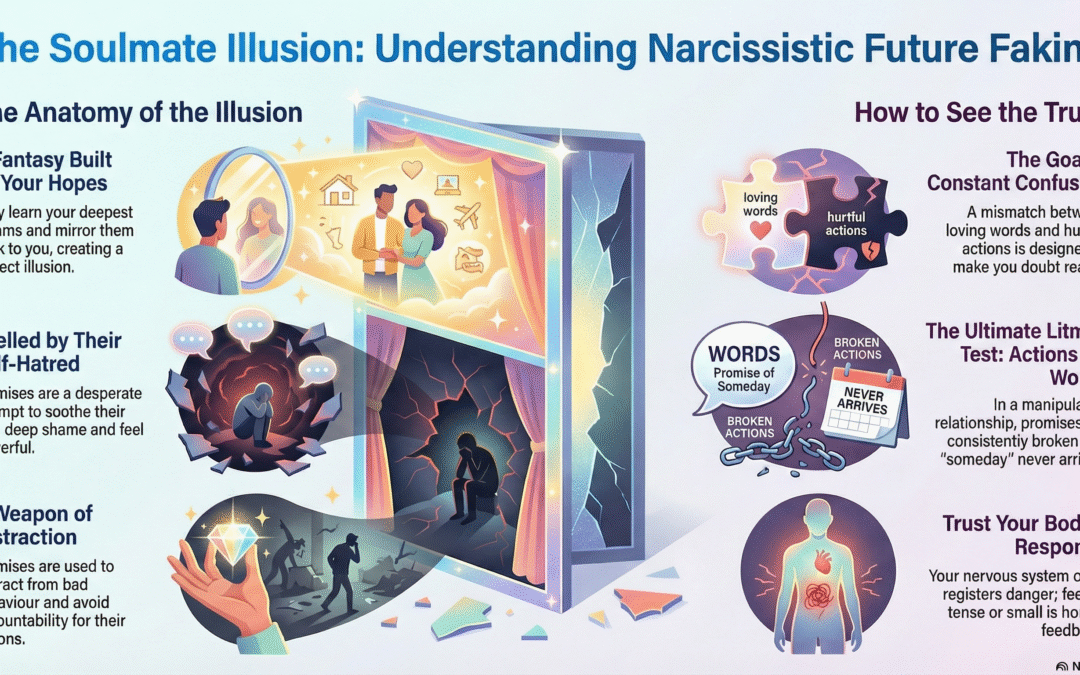
1. It’s Fueled by Their Self-Hatred, Not Your Desirability
While being promised a perfect future feels intensely personal, the counterintuitive truth is that it has very little to do with your value. The narcissist’s promises are a desperate attempt to soothe their own deep-seated psychic pain.
Psychologists agree that narcissism is not rooted in self-love, but in profound self-hatred and shame. This deep shame often stems from a childhood where love was conditional, teaching them that their authentic self was fundamentally unlovable. By manipulating you into believing their fantasy, they get a fleeting feeling of power and relief from their own sense of weakness and inferiority. When a narcissist manipulates you, it soothes their burning soul “like a wet compress on a fevered forehead.” But the relief is fleeting, trapping them in an addictive cycle of manufacturing illusions to escape their own psychic pain.
2. They’re Selling You a Future Built From Your Own Dreams
A future faker doesn’t create a fantasy from scratch. They are masters of a manipulative tactic called “narcissistic mirroring.” In the early stages of the relationship, they encourage deep, meaningful conversations designed to get you to reveal your most heartfelt desires, hopes, and dreams for the future.
This gives them the exact blueprint they need to construct the perfect illusion. They then mimic your dreams back to you, creating a fantasy based on your own remarks. They’ll want a big family if you do, or to travel the world, or to buy that cottage by the beach you’ve always wanted. This is why the connection feels so rare, magnetic, and uniquely perfect, you believe you’ve finally met your soulmate, when in reality, you’ve met someone who is showing you a carefully constructed reflection of yourself.
3. It’s a Weapon of Distraction, Not Just an Act of Seduction
Future faking isn’t confined to the initial “love bombing” phase used to lure you into a relationship. It is a versatile and powerful tool used to control and manipulate throughout the entire abuse cycle.
It’s a highly effective way to distract from bad behaviour and avoid accountability. Imagine your partner comes home hours late, having missed the dinner you made, without a call or text. When you confront them, instead of apologising, they start painting a grand picture of a lavish dinner they’ll take you to next week at an expensive restaurant. Suddenly, your focus shifts from their present-day neglect to the exciting future promise. The cold spaghetti bolognese is forgotten, and their bad behaviour is swept under the rug.
This tactic is also used for punishment. They will dangle the future you crave, only to snatch it away as punishment, telling you that you would already be engaged if only you weren’t so difficult, or that the dream vacation is on hold because you “ruined the mood.” This turns your own dreams into a leash. Furthermore, it is a common “hoovering” tactic. When you’ve had enough and try to leave, the narcissist will suddenly promise the very changes or commitments they have always withheld, reeling you back in with the hope that this time things will be different.
4. Its Real Goal of Narcissistic Future Faking Is to Trap You in a State of Confusion.
The constant mismatch between a partner’s loving words about the future and their harmful actions in the present creates a state of profound psychological discomfort known as ‘cognitive dissonance.’ This confusion is not an unfortunate side effect of the manipulation; it is the primary goal.
This tactic is deliberately disorienting. It is designed to make you doubt your own perceptions, question your instincts, and ultimately lose trust in your own reality. This is the painful paradox of hearing someone plan your future home and pets while they refuse to call you their partner in public, or introducing you to their parents as just “a friend.” Your reality splits into two: the beautiful “someday” they promise, and the devaluing “right now” they deliver. By keeping you in a state of confusion, the narcissist maintains control, as you are too busy trying to reconcile their conflicting behaviours to see the abuse for what it is.
“This dissonance is deeply disorienting. Survivors often revisit those hopeful words, trying to reconcile them with painful actions.”
5. The Ultimate Litmus Test: Actions Never Lie
Despite the complex psychological games and carefully crafted illusions, there is a simple and powerful way to see the truth. The ultimate litmus test for future faking is to compare your partner’s words to their actions.
In a healthy relationship, consistency is the hallmark of commitment. Words and actions align. In a manipulative relationship, a pattern of broken promises, shifting goalposts, and a constant state of “someday” are definitive red flags. Beyond just observing, actively listen to your own body. As one therapist notes, your nervous system often registers danger before your mind can name it. Ask yourself: “How does my body feel in their presence? Do I breathe more easily, or do I feel tense, unsure, or small?” That physical response is data. It is the most honest feedback you will ever receive. Trust it.
After years of heartache, one survivor distilled the entire deception into a single, clarifying truth:
“His future ideals never matched his actions.”
Conclusion: Reclaiming Your Present
Future faking is an insidious tactic that works by tethering your emotional well-being to a fantasy that will never materialise. The illusion is a cage built from your own hopes, designed to keep you from seeking a reality where you are free. It keeps you emotionally invested and trapped, always waiting for a “someday” that the abuser has no intention of delivering. They fake a future of commitment, they tell you how hard they are working, even paint a picture of the future, with security in retirement, as I‘m an expert by experience in this. As soon as they have you entrapped, financially dependent, isolated from family and previous connections, the psychological manipulations start.
The first step to breaking free is to stop focusing on their empty promises and start looking at the hard evidence of their present-day actions. By grounding yourself in what is, not what was promised, you can begin to reclaim your sense of self and build a future that is real. It isn‘t easy, and it can be exhausting; however, the more you understand the less harm they can inflict.
Now that you see the illusion, what is one step you can take today to start building a future that is truly your own?

Discover the truth behind the “Spanish retirement dream” that turned into a calculated nightmare of betrayal.
For eleven years, the author (writing as Loren Keeling) believed she was building a future with a man who promised her security, love, and a shared life in the sun. PH meticulously crafted a narrative of “future faking,” altering greeting cards to read “us” and “our” and promising that his hard work in the UK was solely to secure their retirement together. But behind the facade lay a “nine-year lie”, a double life filled with serial infidelity and a calculated attempt to make her totally financially dependent.
Coercive Control, Emotional Manipulation, and Financial Abuse
In her raw and revealing memoir, What Type of Man?, Loren exposes the hidden forms of coercive control, emotional manipulation, and financial abuse that are often missed until it is too late.. She documents her journey from being “collateral damage” to reclaiming her identity and independence, offering a lifeline to other women navigating the ravages of narcissistic trauma. Don’t let your future be someone else’s “pipe dream.” Learn to identify the red flags of a “Casanova psychopath,” understand the systemic legal gaps that leave cohabiting women unprotected, and discover the proven strategies for healing and recovery.
Transform your path from trauma to independence.