
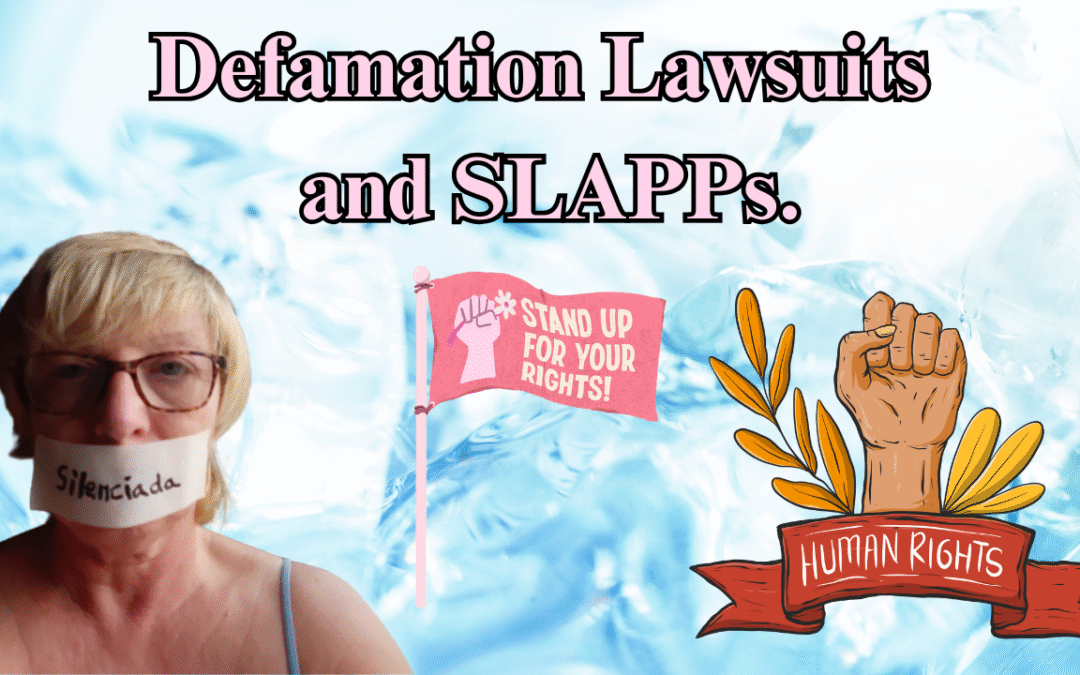
Strategic Lawsuits Against Public Participation (SLAPPs)
The ability to speak out against injustice is fundamental to a free and equitable society. Yet, for many women, raising their voice against abuse, misconduct, or corruption is met with a chilling legal counter-attack. This attack often comes in the form of defamation lawsuits and, more specifically, Strategic Lawsuits Against Public Participation (SLAPPs). These legal manoeuvres are increasingly weaponised by powerful individuals and entities to silence critics, creating a profound and damaging impact on women’s rights, freedom of expression, and the pursuit of justice.
This is a critical issue that cuts across the personal and the public, affecting individuals who speak out about intimate partner violence and post-separation abuse, as well as journalists and activists reporting on broader issues of public interest. Understanding the mechanics of these lawsuits is the first step toward advocating for meaningful change.
The Core Concept: Understanding SLAPPs
A SLAPP is not a legitimate lawsuit seeking justice; its primary goal is to intimidate and drain the resources of those speaking out on public interest issues, regardless of the claim’s legal merit. They are often brought by powerful entities, corporations, wealthy individuals, or politicians, whose true objective is to inflict financial ruin and emotional stress upon their targets.
The Financial and Emotional Toll
The impact of a SLAPP is not measured by the final verdict, but by the process itself. By dragging victims through costly, lengthy legal battles, the powerful entity can effectively silence dissent. The financial and emotional strain of defending against an unfounded lawsuit can be crippling, often forcing victims to settle or retract their statements simply because they can no longer afford to fight.
QUOTE
“How ex-partners with power and money can use the legal system to abuse their targets further? Remember, emotional abuse, manipulation, and mind games are all about ‘power and control.’”
Post-Separation Abuse. By Loren Keeling.
This powerful observation from the book on post-separation abuse highlights the cynical use of the legal system as a tool for continued coercion. The legal process itself becomes an extension of the abuse.
Silencing the Survivors: Defamation in the #MeToo Era
The #MeToo movement, while revolutionary in exposing widespread misconduct, has created a new battleground where legal attacks are the weapon of choice. When survivors bravely share their stories of sexual violence, harassment, or abuse, the accused often retaliate by filing defamation claims. The very public example of Johnny Depp and Amber Heard, for example.
Weaponised Litigation
Defamation laws are intended to protect reputation from false statements of fact. However, in the context of gender-based violence, these laws are weaponised. An aggressor, often with significant resources, can initiate a lawsuit that forces the survivor to re-live and legally “prove” their trauma. This burden is particularly heavy in cases of private abuse where corroborating evidence can be scarce.
The psychological toll is immense. The threat of a defamation suit, even a baseless one, forces self-censorship. Women are hesitant to speak to the media, share their experiences online, or even confide in support networks, fearing that their legitimate, truthful story will be met with a costly and emotionally devastating legal attack. The conflict between “the presumption of innocence until proven guilty” comes into play. An alleged perpetrator files defamation against the survivor who speaks out when the Justice system fails the victims, a case is dismissed, or is filed as no further action, which adds to the experience of the survivor’s trauma. The resulting silence is a devastating blow to public discussion about gender-based violence. In the book “How Many More Women?” by human rights lawyer Jennifer Robinson and journalist Keina Yoshida. The authors propose legal and systemic changes to address these injustices and ensure women’s voices aren’t suppressed.
The Double Bind of Abuse
The experience of abuse, particularly post-separation abuse where the aggressor continues to exert control through legal and financial means, can leave survivors in an impossible “double bind.” Legal professionals often provide conflicting advice, with choices between:
- Report abuse: Risking a retaliatory litigation abuse in Family or Civil Courts, and the financial and emotional cost of legal defence if the abuser uses DARVO tactics. Deny abuse. Attack the victim. Reverse, Victim and Offender.
- Don’t report abuse: Allowing the abuse to continue unacknowledged and unchecked. Attempt to co-parent, negotiate a divorce settlement, or a financial settlement after the end of a cohabiting relationship.
When a survivor is forced to call out the abuse publicly, they do so as a means of protection for themselves and their children. The conflicting legal pressure is a mechanism that reinforces patriarchal structures by making it unsafe and prohibitively expensive for women to exercise their right to free expression. This is why legal backlash against survivors is rightly described as a SLAPP; it restricts their public participation in the critical discussion about violence against women.
The European Response to Legal Abuse
The threat of SLAPPs is a global concern, and Europe has seen a concerning rise in these lawsuits, often targeting journalists and activists reporting on corruption or human rights abuses. The file on European SLAPPs identifies the victims as often being journalists, human rights defenders, NGOs, academics, and civil society.
The New EU Anti-SLAPP Directive
In a major step forward, the European Union introduced the Anti-SLAPP Directive (2024/1069), which entered force in May 2024. This directive is specifically designed to offer procedural safeguards for cross-border cases within the EU. The key protections include:
- Early Dismissal: Courts can now dismiss cases that are “manifestly unfounded” at an early stage.
- Cost Recovery: Victims have the potential to recover their full legal costs, which acts as a deterrent against abusive litigation.
The Directive aims to stop powerful litigants from forum shopping, launching a SLAPP in a jurisdiction with weak protections to maximise the burden on the victim.
Progress and the Road Ahead
While the EU Directive is a significant legislative victory, implementation is slow. EU states must transpose the Directive into their national laws by May 2026. Until this happens, and until national laws are robustly strengthened to protect domestic cases, women and other public watchdogs remain vulnerable.
This legislative response demonstrates an increasing international recognition that using the law to suppress legitimate public interest speech, whether it’s about political corruption or personal abuse, is a serious threat to democracy and justice. The global efforts of groups like the Coalition Against SLAPPs in Europe (CASE), which tracks cases and advocates for change, are essential to holding the line against this abuse of process.
In the UK the SRA (Solicitors Regulation Authority) have issued a “Warning Notice” to its members. Reminding solicitors they must uphold ethical duties, only pursue properly arguable cases, and not become “hired guns” for abusive litigation, with potential disciplinary action for those involved in such cases.
Empowering the Silenced
Countering the chilling effect of SLAPPs and retaliatory defamation claims requires a multi-faceted approach, combining legal reform with societal shifts and personal empowerment.
1. Robust Anti-SLAPP Legislation
The most effective tool is the widespread adoption of strong Anti-SLAPP legislation that applies to all forms of public interest speech, including that made by survivors of gender-based violence. These laws must allow judges to quickly dismiss cases that are clearly intended to silence, and must impose sanctions on those who file abusive suits.
2. Legal Support and Awareness
Organisations providing legal aid and support for survivors facing legal action are critical. By providing access to expert lawyers, the power imbalance between the aggressor and the survivor can be partially mitigated. Moreover, public awareness, such as that raised by books documenting these abuses, is crucial. This empowers not only survivors but also professionals in the legal, social, and health fields to better understand the systemic failings.
3. Understanding the Abuse of Process
For anyone considering speaking out, or for those supporting them, it is vital to recognise the threat of a SLAPP or retaliatory defamation claim for what it is: an act of abuse designed to maintain power and control. It is not a legitimate challenge to the truth of their experience, but an attempt to use the cost and complexity of the legal system as a weapon.
The Takeaway
The misuse of defamation lawsuits and the rise of SLAPPs have created a perilous environment for women who seek to expose abuse and corruption. The legal system, intended as a shield for the truth, has been transformed into a sword wielded by the powerful to enforce silence and perpetuate systemic inequality. While new EU directives offer a glimmer of hope, the fight for true freedom of expression remains ongoing.
The most potent counter-measure is a collective refusal to be silenced and a dedication to legal reforms that dismantle the weapons of intimidation.
Will the next wave of legal reform finally tip the scales of justice back toward the truth-tellers, or will the chilling effect of abusive litigation continue to suppress women’s voices?
If you’re interested in learning more about how individuals overcome legal and psychological abuse, this video discusses a personal experience that resonates with this topic: Post-Separation Abuse. A survivor’s legal journey.
The book was written by a survivor of post-separation abuse, who was failed by the legal profession and the justice system in Spain.
First published in May 2022, while under the legal intimidation of a former partner who had abandoned her in what was meant to be their Spanish retirement home. Two weeks after he left in October 2020, the ex-partner decided to take legal action in the Spanish civil court using “precarious eviction laws” to avoid paying the financial settlement that he had at first promised.
Using the DARVO tactic of deny abuse, attack the victim, reverse the victim and the offender. He weaponised the author‘s economic vulnerability with direct threats. In the weeks that they were still together in the home, after the discard, the first threat was six days after his “Dear Loren” letter of his intention to pay a financial settlement that he termed a “gift”. His words were, “Do not fuck about with me, I‘m in control, you do as I say or I can throw you out onto the streets”. This came after he had terminated the eleven-year relationship with just four sentences, after they had been entertaining friends, and he had asked her to sit on his knee and give him a kiss in front of the guests.
As soon as the guests had left, he suggested a “nightcap” and went to pour two drinks.
The four-sentence discard speech went like this.
“I’ve got something to tell you. I‘m in love with another woman. We can remain friends if you want to remain friends. We just can’t have sex anymore.”
Boom! That was it. The start of the escalation that led to post-separation, legal intimidation and litigation abuses.
By October 2022, the author of this book was not only threatened with “precarious eviction”, but she also had seven criminal allegations made against her. The ex-partner had hired a lawyer in Barcelona who requested maximum penalties. The court documents had the allegations written out in CAPITALS IN BOLD and UNDERLINED with the article of law and the prison sentence requested. The cumulative total added to seventeen years in prison.
Support LifeChangePlans with a project to set up a global non-profit. Order a copy of the Book Or make a Donation. Share the story and help support more women. Every little bit helps. Thank You.