
Bias, discrimination, and misogynistic attitudes persist in the police, social services, and the legal system (solicitors and judges) primarily because these institutions are reflective of broader societal patriarchal norms, ingrained structural cultures, and a slow, often resistant process of systemic change. Despite reforms, these systems can perpetuate inequality through both explicit prejudice and, often more commonly, unconscious bias that affects decision-making.
This is not my opinion, it is my lived experience after five years of post-separation legal intimidation, litigation abuse and institutional sexist violence that took place in Murcia, Cartagena, Spain.
In the Health Sector. I had been given an urgent Psychiatric appointment by the local doctor, who had said I was suffering anxiety. Urgent was four months after I had made the gender violence report. The February 2021 appointment was after the second hearing of the women’s court. I was turned away on the day because I did not understand that I needed to have a translator with me. I never booked any further appointment. Language discrimination happened again in 2022 in the civil court verbal hearing, as not understanding Spanish was used by the lawyer as the main reason to not ask questions in the hearing.
Ingrained Cultural Norms and “Systemic” Misogyny
Institutional Culture: Police and legal institutions often operate with deeply embedded cultures of “hegemonic masculinity,” where male dominance is normalised. This environment can make it difficult for women to advance and can lead to the marginalisation or harassment of female staff.
Normalisation of Behaviours: Misogyny in these sectors is often masked by a “cultural acceptance” of sexist behaviour, where intimate partner violence is sometimes treated less seriously than other crimes.
Solidarity Over Accountability: In policing, a strong sense of camaraderie, while necessary for teamwork, can turn into a “blue wall of silence,” where calling out colleagues for misconduct or misogyny is viewed as disloyal.
Voices of Victims are ignored
I was advised by a Spanish solicitor to file a gender violence complaint after a former partner had used intimidation and threats, anger and verbal aggression after he terminated our relationship. I was shocked to be told I needed to file a complaint with the Police or Guardia Civil. I didn‘t want to report him. I asked the solicitor if he could write to our solicitor, who was now acting for the ex. I was told again that I needed to make a complaint. The solicitor said to me, “Did you not hear what he said? You can not negotiate with him.”
Link to Audio Clip 8: This is what the solicitor heard before giving me advice to file the gender violence complaint.
Police (Guardia Civil): I was questioned by the Guardia Civil regarding false theft allegations in January 2023 without a lawyer present, an act my solicitor confirmed was against the Spanish Constitution. Furthermore, when I first attempted to file a gender violence complaint, officers told me I did not need a solicitor, contradicting the advice from the national 016 helpline. A further attempt to file a complaint about the false criminal allegations and the fabricated court statements was also sabotaged. I had written my complaint in English and Spanish I still had no legal representation when I reported. Now I realise why it is important because what you report and what the police statement that goes to the court says are two different things.
Lack of Diversity and Representation
Male-Dominated Leadership: Many legal professions, especially in higher judiciary roles or senior police ranks, remain male-dominated. This lack of diversity can lead to a “male-centric perspective” in how laws are applied and interpreted.
Slow Change: Despite increasing diversity, the slow pace of change means that traditional, male-oriented ways of thinking continue to dominate in decision-making roles
The Judicial System (Cartagena): During a critical verbal hearing in June 2022 regarding the eviction, I was silenced by the public-appointed legal defender, who denied me the opportunity to speak or present evidence, and the plaintiff was not questioned. (Even though she knew I had previously reported the ex-partner for gender violence that had been dismissed the previous year.) When I attempted to hand a letter to the judge, my own solicitor snatched it back, and the judge threatened to have me removed by the Guardia Civil when I questioned what had just happened. Two years later, I discovered that both cases, the eviction and the gender violence, were heard by the same judge, without a recusal.
Unconscious Bias and Stereotyping
Implicit Bias: Police officers, social workers, and legal professionals are not immune to societal prejudices. Unconscious biases, preconceptions about race, gender, or class, often influence who is considered a “credible victim,” a “problem family,” or a “suspect”.
Stereotyped Assumptions: Misogynistic attitudes lead to stereotypes where women’s accounts of violence are questioned, particularly if they do not fit the “ideal victim” stereotype.
My experiences with Social Services started in 2022 when I was instructed by the public defender to attend and request a vulnerability report. I had run out of money in 2022 my bank account went overdrawn.
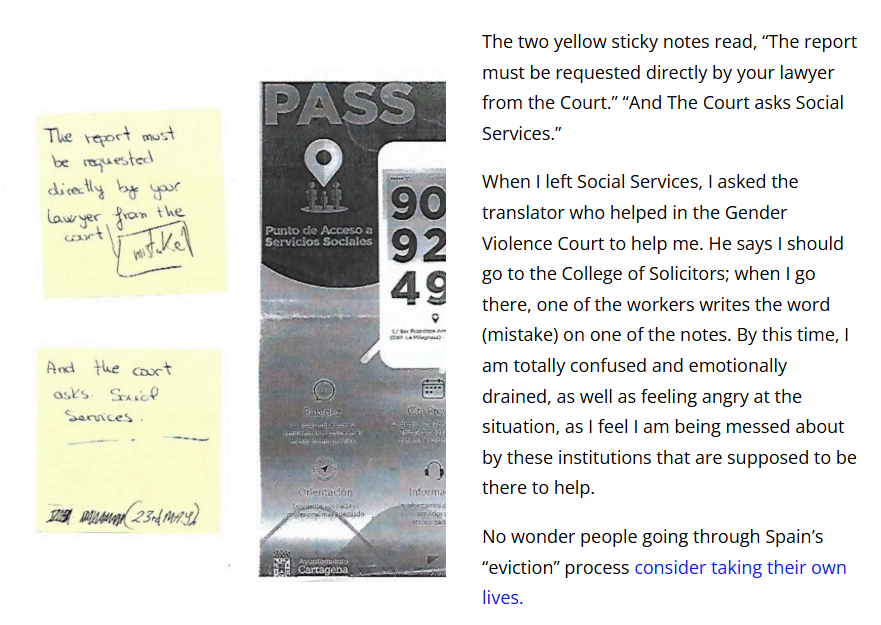
Social Services Failures: The “Social Services Fiasco,” when I attended the service as an English foreigner who did not speak fluent Spanish. I was traumatised when I was informed that it was the lawyer who asked the court, and the court that asked Social Services for the vulnerability assessment. I was given two handwritten sticky notes that spelt out the correct procedure, illustrating a systemic failure to provide the support she was entitled to as a vulnerable person.
No wonder people going through Spain‘s eviction process consider taking their own lives.
Structural Resistance to Reform
Defensiveness and Denial: Institutions often resist admitting to having a “problem” with misogyny, leading to defensive attitudes rather than structural reform.
Ineffectiveness of Training: While anti-bias training is common, it is often a one-day, tick-box exercise rather than an integrated, ongoing process. Research suggests these trainings are often ineffective at changing long-term behaviour.
Lack of Accountability: It is often difficult to have complaints upheld against authority figures like judges or senior officers, meaning behaviours go unpunished
Media and Societal Influence
Normalisation of Prejudices: Law enforcement and legal systems do not exist in a bubble; they are affected by a societal and media environment that can normalise sexist or racist views, which in turn influences officer actions.
In summary, the persistence of these issues is not solely due to “bad apples” but rather a combination of embedded cultural norms, lack of representation, unconscious prejudices, and resistance to accountability within the system itself.
Press Release February 2026
QUOTE
The United Nations has promoted greater participation of women in the justice sector, and evidence shows that increased female representation within judicial institutions advances more victim-centred approaches to justice. This is particularly relevant in responding to violence against women and domestic violence, which constitute violations of fundamental rights. Legal systems must be responsive to the needs of victims by ensuring adequate protection and remedies, yet many women still face substantial barriers in reporting abuse and accessing legal support. Many women and girls, particularly those facing multiple and intersectional forms of discrimination, experience the justice system as lacking sensitivity to the realities of vulnerable groups.This recommendation calls on the Council to reconfirm the EU’s commitment to gender equality and to ensure that women’s rights are fully implemented in all aspects of EU external action through an inclusive, intersectional, and adequately funded approach. It also stresses the need for the full involvement of Parliament and its Committee on Women’s Rights and Gender Equality in shaping the EU’s position at the 70th session of the UN Commission on the Status of Women.
The recommendation further pledges strong support for UN Women as the central actor within the UN system for advancing women’s rights and calls on all UN member states, together with the EU, to provide adequate funding. It underlines the importance of ambitious and complementary European and international instruments, with robust provisions to guarantee women’s empowerment and access to justice, including access to legal aid and consideration of specialised courts for gender-based violence. Protecting women’s rights through effective justice systems builds a path to fairer societies, in line with the effective implementation of the 2030 Agenda for Sustainable Development (SDG16)
Trauma-Informed Approaches
Maybe we should be talking about “trauma-informed” approaches for survivors that focus on protection and remedies, actually listening to the survivor and not “victim-centred approaches to justice” but focus more on the crimes and actions of the perpetrator abusers. All very well saying “innocent until proven guilty”, but when “survivors” know the truth of what happened and society and the system fail to validate, protect and compensate, where does that leave the survivors? They know that predators /abusers are walking free. They know that their future lives will never ever be the same again, and not all victims survive the systemic failures.
The meme image below reflects my thoughts. Like I said before, as an author who self-published my story and was hauled through a criminal court procedure in Spain for sharing what happened and telling the truth about post-separation abuse.
DARVO and SLAPP rolled into one.

Dead women can not make complaints or
write books about what happened to them.
Link to chapter 12: What Type of Man? Provided anonymously by a survivor. Stuck. Why do women stay?
A short explainer video generated in NotebookLM – created from the sources.
Research Sources
https://righttoequality.org/misogyny-in-the-legal-system
https://research.brighton.ac.uk/en/publications/women-after-policing-reflections-on-police-culture-and-misogyny/
https://bylines.cymru/politics-and-society/the-effects-of-misogyny-in-public-office/
https://irr.org.uk/research/statistics/criminal-justice/
https://pmc.ncbi.nlm.nih.gov/articles/PMC8304614/
https://www.bbc.co.uk/news/uk-68877823
https://law-school.open.ac.uk/research/research-clusters/feminism-law-and-gender/iwd-2022-womens-legal-landmarks/sexism-and
PDF – report HMICFRS His Majesty’s Inspectorate of Constabulary and Fire and Rescue Services.
https:/sets-hmicfrs.justiceinspectorates.gov.uk/uploads/inspection-of-vetting-misconduct-and-misogyny-in-the-police.pdf
https://rapecrisis.org.uk/news/baroness-casey-report-shows-misogyny-racism-and-homophobia-are-rife-in-met-police
Reporting Institutional Sexist Violence in Spain
https://ovim.org/en/